24 October 2011

Feel Flows: The Films of Phil Solomon

FEEL FLOWS: THE FILMS OF PHIL SOLOMON
London Tate Modern
24 & 27 October 2011

On his first visit to the UK, Phil Solomon presents two programmes of his alchemical film work. By treating the celluloid surface with a variety of substances and techniques, Solomon transforms images to construct an emotionally charged and deeply affecting cinema. Often elegiac in tone, his symphonic approach makes the personal profound.
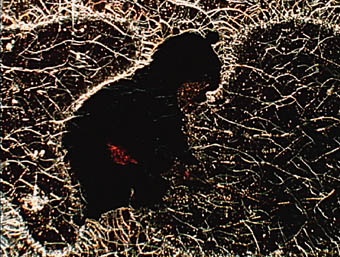
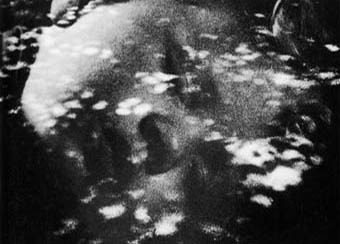
The Snowman (Phil Solomon, 1995)
This survey of Solomon’s 16mm films also features Rehearsals for Retirement, a machinima work from the digital series In Memoriam (for Mark LaPore), made with imagery drawn from the Grant Theft Auto videogames. Programme two includes Seasons…, a collaboration with Solomon’s colleague, friend and mentor, Stan Brakhage.

“Although part of a long avant-garde tradition, Solomon makes films that look like no others I’ve seen. The conceit of the filmmaker as auteur has rarely been more appropriate or defensible – the liberating effect of Solomon’s work suggests a rather different realm: Film Meets Vision, Rejoice!” (Manohla Dargis, New York Times)

Curated by Mark Webber and presented in association with The 55th BFI London Film Festival. Solomon will premiere American Falls at BFI Southbank on Sunday 23 October.
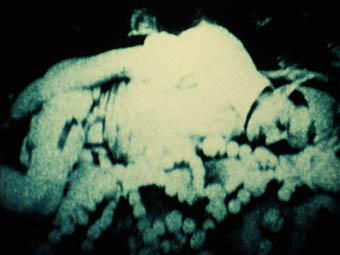
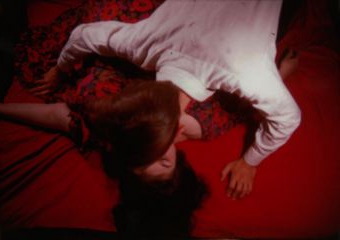
The Exquisite Hour (Phil Solomon, 1989/94)

Monday 24 October 2011, at 7pm
PHIL SOLOMON: PROGRAMME 1

THE EXQUISITE HOUR
Phil Solomon, 1989/94, 16mm, colour, sound, 14 min
“… Partly a lullaby for the dying, partly a lament of the death of cinema … [it] is dedicated to the memory of my grandparents, Albert Solomon, who was a projectionist for Fox, and Rose Solomon, who took tickets at Lowe’s Paradise in the Bronx.” (Phil Solomon)

THE SNOWMAN
Phil Solomon, 1995, 16mm, colour, sound, 8 min
“A meditation on memory, burial and decay – a belated kaddish for my father.” (Phil Solomon)

CLEPSYDRA
Phil Solomon, 1992, 16mm, b/w, silent, 15 min
“Solomon has evolved his technique so that in his latest work (‘Clepsydra’ – ‘waterclock’) the textures are constantly changing and are often appropriate to each figure in metaphoric interplay with each figure’s gestural (symbolic) movement. He has, thus, created consonance with thought as destroyer/creator – a Kali-like aesthetic ‘There is a light at the end of the tunnel’ (Romantic); and it is a train coming straight at us: … (and, to balance such, perhaps, with a touch of Zen) … it is beautiful!” (Stan Brakhage)

PSALM III: “NIGHT OF THE MEEK”
Phil Solomon, 2002, 16mm, b/w, sound, 23 min
“It is Berlin, November 9, 1938, and, as the night air is shattered throughout the city, the Rabbi of Prague is summoned from a dark slumber, called upon once again to invoke the magic letters from the Great Book that will bring his creature made from earth back to life, in the hour of need. A kindertodenliede in black and silver on a night of gods and monsters.” (Phil Solomon)

REHEARSALS FOR RETIREMENT
Phil Solomon, 2007, video, colour, sound, 10 min
“Had I known the end would end in laughter / I tell my daughter it doesn’t matter.” (Phil Ochs)
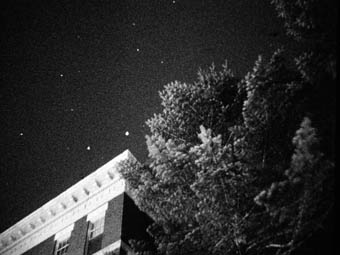
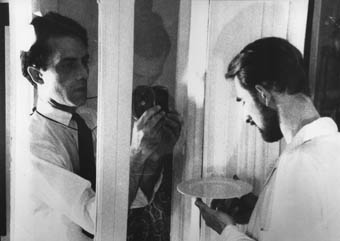
Nocturne (Phil Solomon, 1980)

Thursday 27 October 2011, at 7pm
PHIL SOLOMON: PROGRAMME 2

WHAT’S OUT TONIGHT IS LOST
Phil Solomon, 1983, 16mm, colour, silent, 8 min
“Adopting its title from a poem by Edna St. Vincent Millay, What’s Out Tonight Is Lost is an elegiac film sifting through the unrecoverable. The film is a reflecting pool where vision breaks up. The home we recognize is swallowed in the brume, the light barely penetrates; and the yellow school bus steals us away, delivering us into new clouds, embracing fear. The film has a surface of cracked porcelain and intaglio: the allergic childhood skin of cracks and bruises. This is a film of transubstantiations, the discorporation of human forms into embers. Air looms and blossoms into solidity and nearness … I hear it breathing …” (Mark McElhatten)

PSALM I: “THE LATENESS OF THE HOUR”
Phil Solomon, 2001, 16mm, colour, sound, 10 min
“A little Nachtmusik, a deep blue overture to the series. Breathing in the cool night airs, breathing out a children’s song; then whispering a prayer for a night of easeful sleep. My blue attempt at a sequel to Rose Hobart.” (Phil Solomon)

NOCTURNE
Phil Solomon, 1980, 16mm, b/w, silent, 10 min
“Its setting is a suburban neighbourhood populated by kids at play and indistinct but ominous parental figures. A submerged narrative rehearses a type of young boy’s night-time game in which a flashlight is wielded in a darkened room to produce effects of aerial combat and bombardment. A sense of hostility tinged with terror seeps into commonplace movements … Fantasy merges with nightmare, a war of dimly suppressed emotions rages beneath a veneer of household calm … In Nocturne, found footage is worked so subtly into the fabric of threat that its comes as a shock ploughed from the unconscious.” (Paul Arthur)

SEASONS ...
Phil Solomon & Stan Brakhage, 2002, 16mm, colour, silent, 15 min
“Brakhage’s frame by frame hand carvings and etchings directly into the film emulsion, sometimes combined with paint, are illuminated by Solomon’s optical printing, then edited by Solomon into a four part seasonal cycle‚. This film can be considered to be part of a larger work by Brakhage entitled “…”. Seasons… is inspired by the colours and textures found in the woodcuts of Hokusai and Hiroshige, and the playful sense of forms dancing in space from the filmworks of Robert Breer and Len Lye.” (Phil Solomon)

REMAINS TO BE SEEN
Phil Solomon, 1989/94, 16mm, colour, sound, 17 min
“In the melancholic Remains to Be Seen, dedicated to the memory of Solomon’s mother, the scratchy rhythm of a respirator intones menace. The film, optically crisscrossed with tiny eggshell cracks, often seems on the verge of shattering. The passage from life into death is chartered by fugitive images: pans of an operating room, an old home movie of a picnic, a bicyclist in vague outline against burnt orange and blue … Solomon measures emotions with images that seem stolen from a family album of collective memory.” (Manohla Dargis, Village Voice)

at

Starr Auditorium
Tate Modern, Bankside, London, SE1 9TG
Nearest Tube: Southwark / London Bridge / Blackfriars
MAP OF AREA

Tickets: £5 / £4 concessions, booking recommended
Box Office: 020 7887 8888
www.tate.org.uk

Labels: , , ,

21 October 2011

London Film Festival 2011

LONDON FILM FESTIVAL: EXPERIMENTA WEEKEND
London BFI Southbank
21-23 October 2011

The Experimenta Weekend is the London Film Festival’s annual survey of artist’s film and video. Over three days, from 21-23 October 2011, a unique sequence of programmes will offer a curated selection of outstanding work made around the world.

Phil Solomon, renowned for his exquisite 16mm films, will make his first appearance in the UK to introduce the epic American Falls. In a triptych of images, waves of chemically treated celluloid reflect the aspirations and tragedies of the American dream.

Two festival regulars return with debut features: Lewis Klahr’s elliptical narrative The Pettifogger further develops his distinctive cut-out animation techniques; Ben Rivers’ Two Years at Sea mixes fact and fantasy in an extended study of a marginal outsider. Observational filmmaker Robert Fenz and Portuguese artist Gabriel Abrantes are featured in solo screenings.

Contemporary moving image owes much to the pioneering generation of avant-garde filmmakers that appear in Pip Chodorov’s documentary Free Radicals. Jonas Mekas, a central figure in that movement’s history, will present two new works of his own: Sleepless Night Stories and Correspondence (in collaboration with José Luis Guerin). The visionary films of West Coast pioneer Chick Strand, which combine experimental, collage and ethnographic styles, can be rediscovered in newly preserved prints.

The Experimenta Weekend is curated by Mark Webber, with assistance from Adam Pugh and Marina Ribera.

Outside the weekend programme, the Festival also includes James Benning's Twenty Cigarettes, plus new preservations of Roberto Rossellini’s The Machine That Kills Bad People and Nicholas Ray’s experimental project We Can’t Go Home Again. See The 55th BFI London Film Festival for full details.

Due to the popularity of the Experimenta Weekend, we now offer several repeat screenings. If programmes are listed as “sold out”, please keep trying as additional tickets are released in the days leading up to the weekend & limited numbers are usually available on the door immediately before each programme begins.

Free Radicals (Pip Chodorov, 2010)
Friday 21 October 2011, at 6:30pm, NFT3
& Monday 24 October 2011, at 4:15pm, NFT3
& Monday 24 October 2011, at 7pm, STUDIO
FREE RADICALS: A HISTORY OF EXPERIMENTAL CINEMA

FREE RADICALS: A HISTORY OF EXPERIMENTAL CINEMA
Pip Chodorov | France 2011 | 82 min

Free Radicals scratches the surface of the history of avant-garde cinema in Europe and the USA, from early post-war pioneers through to the founding of New York’s Anthology Film Archives, a museum whose screen is the exhibition space. Director Pip Chodorov is well-placed to chronicle the movement – he established the Re:Voir label to distribute tapes and DVDs of artists’ films, and counts many key exponents amongst his friends. In this personal journey through experimental movies, he surveys a generation of artists who pushed the boundaries of the medium. Working without compromise, and without financial rewards, they were forced to create their own support structures in an expression of solidarity. Whilst not claiming to be a definitive documentary, Free Radicals is a discerning introduction to the field, and its informal nature provides a privileged glimpse at the personalities involved. Archival footage of Hans Richter, Nam June Paik and Stan Vanderbeek (drawn from TV programmes made by the filmmaker’s father) supplements new interviews with Chodorov’s distinguished acquaintances (Jonas Mekas, Peter Kubelka, Robert Breer, Ken Jacobs) and generous excerpts from the films themselves.


Two Years at Sea (Ben Rivers, 2011)
Friday 21 October 2011, at 9pm, NFT1
& Monday 24 October 2011, at 1:30pm, NFT1
TWO YEARS AT SEA

TWO YEARS AT SEA
Ben Rivers | UK 2011 | 88 min

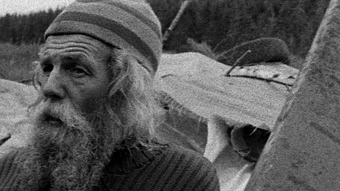
Using old 16mm cameras, artist Ben Rivers, who has been nominated for the Jarman Award and has won a Tiger Award at Rotterdam, creates work from stories of real people, often those who have disconnected from the normal world and taken themselves into wilderness territories. His new long-form work extends his relationship with Jake, a man first encountered in his short film This Is My Land. The title refers to the work Jake did in order to finance his chosen state of existence. He lives alone in a ramshackle house, in the middle of the forest. It’s full of curiosities from a bygone age, including a beloved old gramophone. We see his daily life across the seasons, as he occupies himself going for walks in all weathers, and taking naps in the misty fields and woods. Endlessly resourceful, he builds a raft to fish in a loch. Jake has a tremendous sense of purpose, however eccentric his behaviour seems to us. The presence of the camera is irrelevant to him; he has no desire for human contact, and is completely at home in his environment, the nature around him and his constructed abode. Rivers’ gracefully-constructed film creates an intimate connection with an individual who would otherwise be a complete outsider to us. (Helen de Witt)


Trypps 7 (Badlands) (Ben Russell, 2010)
Saturday 22 October 2011, at 2pm, NFT3
& Thursday 27 October 2011, at 3:45pm, STUDIO
ALTERED STATES

TRYPPS #7 (BADLANDS)
Ben Russell | USA 2010 | 10 min
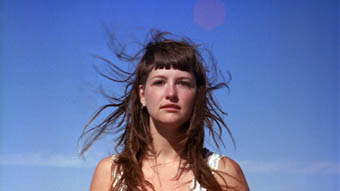
The mirror crack’d: As a young woman, high on LSD, looks toward the camera, the doors of perception swing open for both viewer and subject.

WHILE YOU WERE SLEEPING
Mary Helena Clark | USA 2010 | 9 min
‘This is your life. It rides like a dream.’ (MHC)

SANS TITRE
Neil Beloufa | France 2010 | 15 min
In a reconstruction of a villa occupied by terrorists during the Algerian War, onlookers speculate on the activities that took place.

THE PIPS
Emily Wardill | UK 2011 | 4 min
A gymnast performs, and everything begins to fall away …

…THESE BLAZEING STARRS!
Deborah Stratman | USA 2011 | 14min
Watch the skies! Throughout history, comets have heralded events of grave significance and change; today it is thought that they can reveal facts about the formation of the universe.

THESE HAMMERS DON’T HURT US
Michael Robinson | USA 2010 | 13 min
‘Tired of underworld and overworld alike, Isis escorts her favourite son on their final curtain call down the Nile, leaving a neon wake of shattered tombs and sparkling sarcophagi.’ (MR)

Total running time approximately 70 min


The Return (Nathaniel Dorsky, 2011)
Saturday 22 October 2011, at 4pm, NFT3
& Tuesday 25 October 2011, at 8:45pm, NFT2
NATHANIEL DORSKY / BEN RIVERS

PASTOURELLE
Nathaniel Dorsky | USA 2010 | 17 min
‘A pastourelle and an aubade are two different forms of courtship songs from the troubadour tradition. In this case, the film Pastourelle, a sister film to Aubade, is in the more tumultuous key of spring.’ (ND)

THE RETURN
Nathaniel Dorsky | USA 2011 | 27 min
‘Like a memory already gone, this place of life.’ Dorsky has created a poetic form of cinema in which the screen becomes a site for reverie or transfiguration. In his most recent film, he seems to move towards a more abstract representation of light and being.

SACK BARROW
Ben Rivers | UK 2011 | 21 min
The march of time claims another casualty. Sack Barrow documents (and laments) the out-dated, but functioning, technology of a family owned electroplating factory in the weeks around its closure – its old ways now unsustainable in the modern world.

Total running time approximately 70 min


Palácios de Pena (Gabriel Abrantes, 2011)
Saturday 22 October 2011, at 7pm, NFT3
& Tuesday 25 October 2011, at 1:15pm, NFT2
GABRIEL ABRANTES

LIBERDADE
Gabriel Abrantes & Benjamin Crotty | Portugal-Angola 2011 | 16 min
Liberdade sketches episodes in the relationship between a domineering Chinese immigrant and her Angolan boyfriend with lavishly cinematic panache. Travelling through spectacular locations in and around Luanda, they navigate the complications of their burgeoning identities and the different cultures they represent.

PALÁCIOS DE PENA (PALACES OF PITY)
Gabriel Abrantes & Daniel Schmidt | Portugal 2011 | 56 min
Gabriel Abrantes and his collaborators use the tropes of mainstream cinema to make works that are by turns comical, thought-provoking and transgressive. In a parable on guilt and oppression, which alludes to aspects of Portuguese colonial history, two cousins are potential heirs to their grandmother’s fortune. A new generation may be oblivious to the past, but inherits it nonetheless.

OLYMPIA I & II
Gabriel Abrantes & Katie Widloski | Portugal-USA 2008 | 7 min
Mimicking the composition of Manet’s notorious painting, the artists play out two possible scenarios: between a prostitute and her gay brother, and between a wealthy transsexual and his devoted maid.

Total running time approximately 80 min


Sleepless Nights Stories (Jonas Mekas, 2011)
Saturday 22 October 2011, at 9pm, NFT3
& Tuesday 18 October 2011, at 9pm, VUE3
& Thursday 20 October 2011, at 7pm, STUDIO
SLEEPLESS NIGHTS STORIES

SLEEPLESS NIGHTS STORIES
Jonas Mekas | USA 2011 | 114 min

Jonas Mekas’ opening confession that he suffers from insomnia will come as no surprise to anyone aware if his singular contribution to cinema. Over 50 years he has established and promoted a viable culture for truly independent and avant-garde filmmaking, and his recent acceptance by the art world has brought a long overdue wave of attention and success. Sleepless Nights Stories is the latest in the series of long-form diary films that Mekas has been making since his arrival in the USA in 1949. Eating, drinking, singing and dancing with friends, the tireless octogenarian is full of life and wonder, casually weaving together contemporary folk tales collected during travels across the globe. Marina Abramovic fantasizes about domesticity, Lee Stringer recounts an episode from his crack-addicted past, and the protagonist toasts the ‘working class voice’ of Amy Winehouse. Louis Garrel, Björk, Harmony Korine and Patti Smith also appear. Treating significant and inconsequential moments with equal import, Mekas’ modern day saga presents the first episodes from his ambitious ‘1001 Nights’ project.


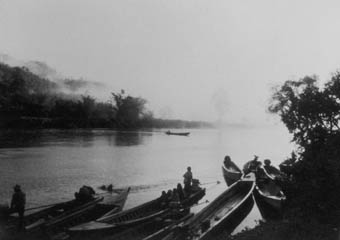
Mosori Monika (Chick Strand, 1970)
Sunday 23 October 2011, at 2pm, NFT3
INTIMATE VISION: FILMS BY CHICK STRAND

As one of the instigators of Canyon Cinema, Chick Strand (1931-2009) was at the heart of 1960s West Coast avant-garde. Her film work, comprising of found footage and personally photographed material, has been rarely seen in the UK and is presented now in newly preserved prints. Strand’s camera is almost continually in motion, catching details in kinetic close-up to convey celebrations of intimacy and the joys of living.

‘For most of her filmmaking career, the integrity of Strand’s vision lay aslant of prevailing fashions, so that only belatedly did the full significance of her radically pioneering work in ethnographic, documentary, feminist, and compilation filmmaking – and above all, in the innovation of a unique film language created across these modes – become clear.’ (David James, The Most Typical Avant-Garde)

CARTOON LE MOUSSE
Chick Strand | USA 1979 | 15 min
In her collage films, Strand uses the magic of editing to conjure surreal humour from the connections between disparate fragments.

MOSORI MONIKA
Chick Strand | USA 1970 | 20 min
The impact of American missionaries on the Warao Indians in Venezuela is considered from the viewpoints of women from each side.

ANGEL SWEET BLUE WINGS
Chick Strand | USA 1966 | 3 min
A multi-layered cine-poem apropos life and vision.

LOOSE ENDS
Chick Strand | USA 1979 | 25 min
Found footage is used to convey the effect of information overload, finding wit and pathos in the complicated synthesis of personal experience and media assault.

ARTIFICIAL PARADISE
Chick Strand | USA 1986 | 13 min
‘The anthropologist’s most human desire: the ultimate contact with the informant. The denial of intellectualism and the acceptance of the romantic heart, and a soul without innocence.’ (CS)

KRISTALLNACHT
Chick Strand | USA 1979 | 7 min
‘Dedicated to the memory of Anne Frank, and the tenacity of the human spirit.’ (CS)

Total running time approximately 90 min

Loose Ends was preserved by Pacific Film Archive, Berkeley. All other films preserved by Pacific Film Archive and Academy Film Archive, Los Angeles, with support from the National Film Preservation Foundation.


American Falls (Phil Solomon, 2010)
Sunday 23 October 2011, at 4pm, NFT3
& Tuesday 25 October 2011, at 4pm, NFT3
PHIL SOLOMON’S AMERICAN FALLS

‘Should anyone imagine that the art of alchemy died with the Middle Ages, Phil Solomon’s American Falls testifies to the contrary: both to the possibilities of photographic and digital transformation and to the magical emanations of their fusion.’ (Tony Pipolo, Artforum)

AMERICAN FALLS
Phil Solomon | USA 2010 | 60 min
In his sublime 16mm films, Phil Solomon chemically alters photographic imagery to create a thick celluloid impasto that infuses footage with profound emotional resonance. For American Falls, Solomon rifles through a collective memory fashioned from both fact and fiction, mixing elements from newsreels, actualities and narrative films in a monumental retelling of American history which draws parallels with and reflects upon the current state of the nation. Houdini, Harold Lloyd, Keaton and King Kong commingle with presidents, gold-diggers, railroad barons and the civil rights movement. ‘My project is ultimately one of great hope, stemming from a life-long love for this American experiment of ours … but it is also necessitated by my deepest concern for its present and future directions.’ Originally conceived as a 360-degree installation around the walls of the Corcoran Gallery of Art’s rotunda, the work has been reconfigured for the cinema as a panoramic view in triptych, with surround sound mix by composer Wrick Wolff.

WHAT’S OUT TONIGHT IS LOST
Phil Solomon | USA 1983 | 8 min
‘The film began in response to an evaporating relationship, but gradually seeped outward to anticipate other imminent disappearing acts: youth, family, friends, time … I wanted the tonal shifts of the film’s surface to act as a barometer of the changes in the emotional weather.’ (PS)
Preserved by Academy Film Archive, Los Angeles.

Total running time approximately 80 min

Phil Solomon will present screenings of his earlier films at Tate Modern on 24 & 27 October 2011.


The Pettifogger (Lewis Klahr, 2011)
Sunday 23 October 2011, at 7pm, NFT3
& Tuesday 25 October 2011, at 7pm, STUDIO
THE PETTIFOGGER

THE PETTIFOGGER
Lewis Klahr | USA 2011 | 65 min
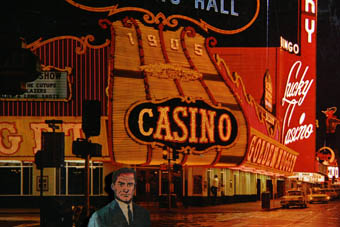
The first feature-length work by Lewis Klahr takes a unique approach to a familiar genre. Ostensibly a thriller that traces events in the life of an American gambler and con man circa 1963, The Pettifogger is described by the filmmaker as ‘an abstract crime film and, like many other crime films involving larceny, a sensorial exploration of the virulence of unfettered capitalism.’ Characters lifted from comic books move through an impressionistic landscape of textures, photographs and drawings, populating a story whose narrative is suggested but not strongly defined. Employing a range of iconography and appropriated audio to expand his signature style of collage animation, Klahr recycles symbols of popular culture to address themes of the loss of innocence and the irresistible allure of wealth.

APRIL SNOW
Lewis Klahr | USA 2010 | 10 min
A love story about cars and girls, carried away by songs from the Shangri-La’s and The Boss.

Total running time approximately 80 min


Correspondence (Robert Fenz, 2011)
Sunday 23 October 2011, at 9pm, NFT3
& Monday 24 October 2011, at 2pm, NFT3
ON THE ROAD WITH ROBERT FENZ

Robert Fenz’s films explore cultural diversity and the human condition with a keen eye reminiscent of his tutors Peter Hutton and James Benning. Mixing improvisation with luminous photography, he offers a poetic but political worldview. An associate of Robert Gardner’s Studio7Arts, Fenz has collaborated with musician Wadada Leo Smith and worked as cinematographer for Chantal Akerman.

THE SOLE OF THE FOOT
Robert Fenz | USA 2011 | 34 min
Filmed in France, Israel and Cuba. ‘Borders (and all the politics attending the drawing of borders) exist to keep some people in (citizenship) and others out. This film is an attempt to capture the presence of people otherwise denied the political right to be at home in some place that is their home, where they have their roots, where they have their being.’ (RF)

CORRESPONDENCE
Robert Fenz | USA 2011 | 30 min
For Correspondence, Fenz travelled to places where the pioneering ethnographic filmmaker Robert Gardner shot three of his best-known films – West Papua (Dead Birds), Ethiopia (Rivers of Sand) and India (Forest of Bliss). While documenting present conditions in these locations, Fenz also constructs an elegy for a form of image-making that is now in decline.

Total running time approximately 65 min


...

Advance booking is highly recommended
Standard ticket price: £10.50
Weekday screenings before 5pm: £7.00
Concessions for weekday screenings before 5pm: £6.00

Book online at www.bfi.org.uk/lff
Telephone Box Office: 020 7928 3232
Book in person at BFI Southbank

For full booking info see www.bfi.org.uk/lff

Labels: , , , , , ,

19 September 2008

Return To The Scene Of The Crime

RETURN TO THE SCENE OF THE CRIME
London Tate Modern
19 September 2008

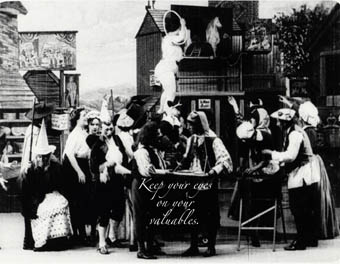
"The heartwarming story of a boy who didn’t know it’s wrong to steal. Running off with the pig seemed like a good idea at the time."

Return to the Scene of the Crime (Ken Jacobs, 2008)

Friday 19 September 2008, at 7pm
RETURN TO THE SCENE OF THE CRIME

In a contemporary riff on one of his landmark works, Ken Jacobs uses new technology to both interrogate and arouse a theatrical tableau, shot in 1905, based on Hogarth’s Southwark Fair. The antique film print is probed, exploded and reconstituted in the digital domain with radical ingenuity and infectious wit. This extraordinary new work teaches us how to see.

Ken Jacobs, Return to the Scene of the Crime, 2008, 92 min

Please Note: This work uses flickering imagery and is not suitable for those susceptible to photo-sensitive epilepsy.

Drinks and cakes will be served after the screening.
For full details of the tank.tv weekend at Tate Modern see Tank at Tate.

An online exhibition at www.tank.tv from 1 October to 30 November 2008 will feature a selection of 20 complete or excerpted works by Ken Jacobs, dating from 1956 to the present. Curated by Mark Webber for tank.tv and Tate Modern.


at

Starr Auditorium
Tate Modern, Bankside, London, SE1 9TG
Nearest Tube: Southwark / London Bridge / Blackfriars
MAP OF AREA

Tickets: £5 / £4 concessions, booking recommended
Box Office: 020 7887 8888
www.tate.org.uk

Labels: , ,

13 June 2008

Tony Conrad

TONY CONRAD
London Tate Modern
13-15 June 2008

Tony Conrad is a pivotal figure in contemporary culture. His multi-faceted contributions since the 1960s have influenced and redefined music, filmmaking, minimalism, performance, video and conceptual art.

2004 performance of Ten Years Alive on the Infinite Plain (1972)
Known for his groundbreaking film The Flicker, his involvement in the Theatre of Eternal Music and the evolution of the Velvet Underground, and collaborations with a host of luminaries including Jack Smith, John Cale, Mike Kelley and Henry Flynt, Conrad is a radical artist who challenges our understanding of art history.

This special weekend event at Tate Modern will feature a major new performance for the Turbine Hall and screenings of his extraordinary film and video work.

Tony Conrad curated by Stuart Comer, Alice Koegel and Mark Webber.

The Flicker (Tony Conrad, 1966)

Friday 13 June 2008, at 7pm
FLICKER AND PROCESS FILMS

Minimal cinema with maximal effect. Few films provide the intense, stroboscopic viewing experience of The Flicker, a non-objective film composed only of opaque and clear frames, and a pulsing electronic soundtrack. Conrad’s cinematic debut still astounds audiences four decades after its creation, and will be screened together with other works exploring audio-visual harmonics and the radical production processes of cooked and electrocuted films.

Tony Conrad, The Flicker, 1966, 30 min
Tony Conrad, Curried 7302, 1973, 2 min
Tony Conrad, 7302 Creole, 1973, 1 min
Tony Conrad, 4-X Attack, 1973, 2 min
Tony Conrad, Film Feedback, 1974, 14 min
Tony Conrad, The Eye of Count Flickerstein, 1967/75, 7 min
Tony Conrad, Articulation of Boolean Algebra for Film Opticals, 1975, 10 min excerpt
Beverly & Tony Conrad, Straight and Narrow, 1970, 10 min

The screening, introduced by Tony Conrad, will be followed by a drinks reception to celebrate the publication of Beyond the Dream Syndicate: Tony Conrad and the Arts after Cage by Branden W. Joseph (Zone Books/MIT).

In Line (Tony Conrad, 1986)

Saturday 14 June 2008, at 7pm
TONY TAKES ON VIDEO: WHO'S WATCHING WHO?

Tony Conrad investigates the conditions of video production and presentation in a series of tapes which deconstruct or re-appropriate the techniques of TV. Exploiting the reflexive nature of the medium, he critiques the electronic image and notions of history, theory and authority with an irreverent sense of humour. Postmodernism was never this much fun!

Tony Conrad, Concord Ultimatum, 1977, 10 min excerpt
Tony Conrad, Redressing Down, 1988, 18 min
Tony Conrad, Ipso Facto, 1985, 7 min
Tony Conrad, Lookers, 1984, 4 min excerpt
Tony Conrad, Egypt 2025, 1986, 13 min
Tony Conrad, No Europe, 1990, 13 min
Tony Conrad, Accordion, 1981, 5 min
Tony Conrad, In Line, 1986, 7 min

The artist will introduce this programme of rarely seen works.

Tony Conrad, 2003 performance at De Stijl / Freedom From Festival

Saturday 14 June 2008, at 10pm
UNPROJECTABLE: PROJECTION AND PERSPECTIVE

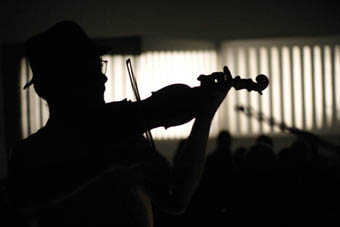
UNPROJECTABLE: PROJECTION AND PERSPECTIVE, a major new live performance by Tony Conrad, is specially conceived for the latent sound and immense scale of the Turbine Hall. Emerging from an installation inspired by the hum of the former power station’s one remaining generator, Conrad’s sonic and visual feast will incorporate an amplified string quartet, electric drill and motors, phonograph arms, film projection and shadows which loom high above the audience.

This is a FREE event as part of UBS Openings: Saturday Live.

Please Note: This event is FREE but advance booking is recommended by telephone 020 7887 8888, email ticketing@tate.org.uk or online.

DreaMinimalist (Marie Losier, 2008)

Sunday 15 June 2008, at 3pm
TONY CONRAD IN CONVERSATION + DREAMINIMALIST

Tony Conrad will discuss his radical breakthroughs in film, video, music and performance with Branden W Joseph, Associate Professor of Modern and Contemporary Art at Columbia University, and author of Beyond the Dream Syndicate: Tony Conrad and the Arts after Cage (Zone Books/MIT).

The discussion will include a screening of DreamMinimalist (Marie Losier, 2008, 25 min), the latest in Marie Losier's ongoing series of film portraits of avant-garde directors (Mike and George Kuchar, Guy Maddin, Richard Foreman). The film offers an insightful and hilarious encounter with Conrad as he sings, dances and remembers his youth and his association with Jack Smith.


at

Tate Modern
Bankside, London, SE1 9TG
Nearest Tube: Southwark / London Bridge / Blackfriars
MAP OF AREA

Screenings & Discussion Tickets: £5 / £4 concessions
Performance Tickets: FREE, booking recommended (see above)
Box Office: 020 7887 8888
www.tate.org.uk

Labels: , ,

07 March 2008

Gregory J. Markopoulos

GREGORY J. MARKOPOULOS
London Tate Modern
7 & 8 March 2008

Gregory J. Markopoulos (1928–1992) was a key figure in the evolution of the New American Cinema of the 1960s, an archetypal personal filmmaker who counted Jack Smith, Kenneth Anger, Stan Brakhage and Maya Deren amongst his contemporaries. His ravishing films are a complex combination of masterful camerawork and editing with a strong vision rooted in myth and poetry.

After relocating from New York to Europe in 1967, he planned the construction of an archive and projection space in Greece – The Temenos – a setting that would be in harmony with his extraordinary films. This pair of Tate Modern screenings anticipates the Temenos 2008 open air premieres of Markopoulos’ ENIAIOS III-V to be held in Lyssaraia on 27-29 June 2008, presented by the filmmaker Robert Beavers.


Gregory J. Markopoulos directs Jack Smith

Friday 7 March 2008, at 7pm
MARKOPOULOS: PORTRAITS OF ARTISTS

Markopoulos made many extraordinary film portraits, which often incorporate an activity or object that has personal significance to the subject. This programme presents a selection of poetic and sensuous portraits of cultural and art world luminaries such as Gilbert & George, Alberto Moravia, Giorgio de Chirico and Rudolph Nureyev.

“The films preserve the myriad flights of isolated, spectrally splintered and itinerant spirit, lost in yearning, in search of intuitive wholeness while negotiating mazes of desire, seeking sanctuary in the reflection of countless identities. The works hold a shimmering mirror up to the contradictory compulsions of an era, set to register, for a few instants, shocks of recognition.” (Kirk Winslow, Millennium Film Journal)

Gregory Markopoulos, Through a Lens Brightly: Mark Turbyfill, 1967, 12 min (Mark Turbyfill)
Gregory Markopoulos, ENIAIOS (Order III, Reel 1) (Gibraltar), undated, 15 min
(Gilbert & George)

Gregory Markopoulos, ENIAIOS (Order IV, Reel 6) (The Olympian), 1969, 23 min (Alberto Moravia)
Gregory Markopoulos, Political Portraits, 1969, 15 min excerpt
(Ulrich Herzog, Marcia Haydee, Rudolph Nureyev, Giorgio di Chirico, Hulda Zumsteg)
Gregory Markopoulos, ENIAIOS (Order II, Reel 2), undated, 23 min
(Hans-Jakob Siber, Franco Quadri, Giorgio Frapoli, Klaus Schönherr and family)


The Illiac Passion (Gregory J. Markopoulos, 1967)

Saturday 8 March 2008, at 7pm
MARKOPOULOS: THE ILLIAC PASSION

Throughout his life, Markopoulos remained closely connected to his heritage and ultimately saw the Greek landscape as the ideal setting for viewing his films. The Illiac Passion, one of his most highly acclaimed films, is a visionary interpretation of ‘Prometheus Bound’ starring mythical beings from the 1960s underground. The soundtrack of this contemporary re-imagining of the classical realm features a reading of Thoreau’s translation of the Aeschylus text and excerpts from Bartok.

Gregory Markopoulos, The Illiac Passion, 1967, 92 min

“The Illiac Passion, which features chiaroscuro passages reminiscent of Anger's Inauguration of the Pleasure Dome of 1954, and incorporates 25 characters, is loosely based on Aeschylus' ‘Prometheus Bound’. For a viewer seeing this extravagant ode to creation some thirty years after its making, the film's most plangent moments involve Markopoulos' affectionate casting of friends as mythical figures – Andy Warhol's Poseidon pumping on an Exercycle above a sea of plastic, Taylor Mead's Demon leaping, grimacing, and streaming vermilion fringes, and Jack Smith's bohemian Orpheus, spending a quiet afternoon at home with Eurydice.” (Kristin M. Jones, Artforum)


at

Starr Auditorium
Tate Modern, Bankside, London, SE1 9TG
Nearest Tube: Southwark / London Bridge / Blackfriars
MAP OF AREA

Tickets: £5 / £4 concessions, booking recommended
Box Office: 020 7887 8888
www.tate.org.uk

Labels: , ,

29 October 2007

Peter Hutton

PETER HUTTON IN THE ELEMENTS
London Tate Modern
Monday 29 October 2007, at 7pm

Films by Peter Hutton appear more closely related to landscape painting and still photography than contemporary cinema. In their stately portrayal of urban and rural locations, they afford the viewer a rarefied and highly-focused mode of looking, a stillness seemingly at odds with everyday life. Over shots of extended duration, the world reveals itself before the camera, which often records only subtle changes of light and atmospheric conditions.

Landscape (for Manon) (Peter Hutton, 1986-87)

Peter Hutton began making films in 1970 and has work in the collections of the Whitney Museum, Centre Georges Pompidou, George Eastman House and the Austrian Film Museum. A former merchant seaman, he has been a professor of film at Bard College in the Hudson River Valley since 1985. His most recent film, At Sea, will screen in the London Film Festival on Sunday 28 October.

For this screening at Tate Modern, Peter Hutton will introduce works, made on land and sea, which relate to the elements of earth, air, fire and water.

Curated by Mark Webber.
Presented in association with The Times BFI 51st London Film Festival.

Images of Asian Music (Peter Hutton, 1973-74)

Monday October 2007, at 7pm
PETER HUTTON IN THE ELEMENTS

NEW YORK PORTRAIT, CHAPTER 2
Peter Hutton, 1980-81, b/w, silent, 16 min
The second part of an extended life’s portrait of New York. “Hutton’s black and white haikus are an exquisite distillation of the cinematic eye. The limitations imposed – no colour, no sound, no movement (except from a vehicle not directly propelled by the filmmaker), no direct cuts since the images are born and die in black – ironically entail an ultimate freedom of the imagination. If pleasure can disturb, Hutton’s ploys emerge in full focus. These materializing then evaporating images don’t ignite, but conjure strains of fleeting panoramas of detached bemusement. More than mere photography, Hutton’s contained-with-in-the-frame juxtapositions are filmic explorations of the benign and the tragic.” (Warren Sonbert)

BOSTON FIRE
Peter Hutton, 1979, b/w, silent, 8 min
“Boston Fire finds grandeur in smoke rising eloquently from a city blaze. Billowing puffs of darkness blend with fountains of water streaming in from off-screen to orchestrate a play of primal elements. The beautiful texture of the smoke coupled with the isolation from the source of the fire erases the destructive impact of the event. The camera, lost in the immense dark clouds, produces images for meditation removed from the causes or consequences of the scene. The tiny firemen, seen as distant silhouettes, gaze in awe, helpless before nature’s power.” (Leger Grindon, Millennium Film Journal)

IMAGES OF ASIAN MUSIC (A DIARY FROM LIFE 1973-74)
Peter Hutton, 1973-74, b/w, silent, 29 min
“Images of Asian Music represents footage compiled during 1973-74 when Peter Hutton was living in Thailand and working at sea as a merchant seaman. While the film is silent, the title was intended to evoke a comparison to the movement of classical Asian music. Images of Asian Music is a personal celebration of Asia formed by a sensitivity to filmic composition and to the perception of these images in a silent time created by the filmmaker.” (Whitney Museum of American Art)

LANDSCAPE (FOR MANON)
Peter Hutton, 1986-87, b/w, silent, 19 min
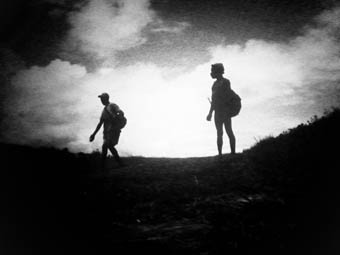
“Much of the imagery in Landscape (for Manon) is suggestive of Thomas Cole’s Catskill paintings – some of Hutton’s imagery was made in and around Kaaterskill Clove. In general, the film recalls those Cole paintings usually seen as forerunners of Luminism – ‘The Clove’, ‘Catskills’ (1827), for example, and ‘Catskill Creek’ (1845) – though the sensibility it reflects and the experience it provides is quite close to Fitz Hugh Lane, Martin Johnson Heade and John Frederick Kensett. Landscape (for Manon) is made up of twenty-two shots. The first and last shots frame the film as a tribute to Hutton’s young daughter, Manon: in the film’s delicate and arresting final shot, we see her face in close-up, double exposed with mottled light.” (Scott MacDonald, The Garden in the Machine)

IN TITAN'S GOBLET
Peter Hutton, 1991, b/w, silent, 10 min
In Titan’s Goblet refers to a landscape painting by Thomas Cole circa 1833. The film is intended as an homage to Cole, who is regarded as the father of the Hudson River School of painting. “Like Landscape (for Manon), In Titan’s Goblet depicts, in a series of often-stunning, silent, black and white, discrete images the Catskill Mountain area. In this case, however, a sequence of lovely images of what at first appears to be mist in the mountains is slowly revealed to be a distant fire of rubber tires that had burned out of control. That is, Hutton’s serene, evocative landscapes are, in this instance, qualified by an environmental problem – one that confronts our hunger for imagery of pristine nature.” (Scott MacDonald)


at

Starr Auditorium
Tate Modern, Bankside, London, SE1 9TG
Nearest Tube: Southwark / London Bridge / Blackfriars
MAP OF AREA

Tickets: £5 / £4 concessions, booking recommended
Box Office: 020 7887 8888
www.tate.org.uk

Labels: ,